


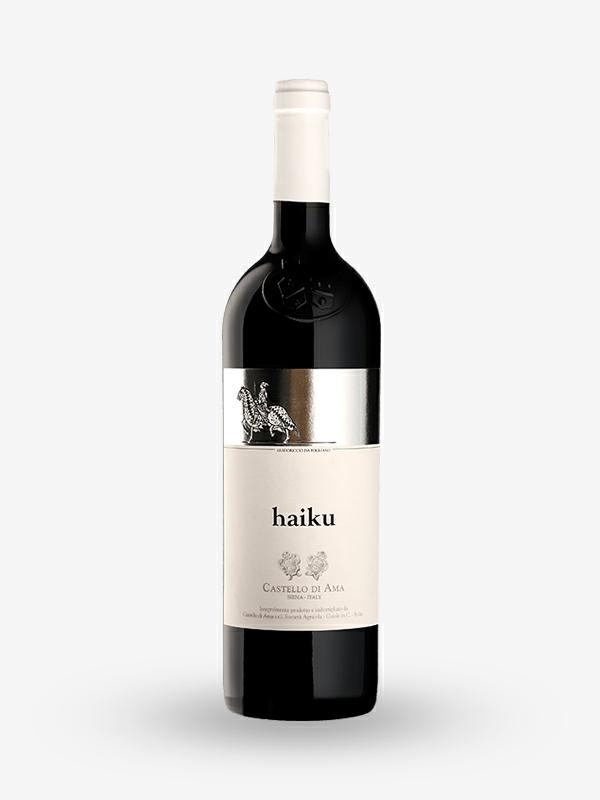
TOSCANA ROSSO IGT 2018 HAIKU CASTELLO DI AMA LT.3,000
TOSCANA ROSSO IGT 2018 HAIKU CASTELLO DI AMA LT.3,000
€ 450,00
Codice
CASTELLODIAMA122
Codice Alternativo:
Categoria Merc:
Vini Rossi Toscana
Unita di Misura:
NR
Annata:
2018 DOPPIO MAGNUM
Produttore:
CASTELLO DI AMA
Uvaggio:
Uvaggio: 50% Sangiovese; 25% Cabernet Franc; 25% Merlot
Non Disponibile
Articolo Esaurito
INFORMAZIONI DEL PRODOTTO
Haiku was first produced in 2009 and is the result of a
blend of three varieties: 50% is
Sangiovese, while the
remainder is split equally between
Cabernet Franc and Merlot. During
the planting of the second section of the Montebuoni Vineyard, completed in 2001, the decision was made to
experiment with a noble international variety, Cabernet
Franc, which had not previously been used at Ama.
However, following a careful
soil and climate analysis, it was hypothesized that
Cabernet Franc could yield good results;
consequently, in 2001, two small plots were planted—
designated in the estate records as numbers
84 and 85, measuring 1.47 ha and 0.47 ha respectively,
for a total area of ??2 hectares—
using clone 214 (a Bordeaux clone prized
for its ability to produce wines suitable for long aging)
on 110R rootstock. Exposure: northwest–southeast
Soil: clay-limestone
Altitude: 508–420 meters a.s.l.
Training system: Merlot and Cabernet Franc are trained using the simple Guyot system, while Sangiovese is trained using the spurred cordon system.
Planting density: 5,200 vines/ha
First vintage produced: 2009
Blend: 50% Sangiovese; 25% Cabernet Franc; 25% Merlot.
Clones: Cabernet Franc 214; Merlot 181 and 343; Sangiovese CH21, CH22, CC 2002, and CC 2004. Rootstock: 420A.
RIFUGIO
Climate:
Summer arrived late, and the onset of veraison occurred in early August. There were splendid sunny days and summer heat until mid-September, when temperatures dropped again—especially at night—delaying the harvest. Picking took place on September 26 for Merlot, October 2 for Sangiovese, and October 12 for Cabernet Franc.
Harvest dates were determined following numerous samples analyzed both organoleptically in the vineyard and in the laboratory. Harvesting was carried out strictly by hand using 10–12 kg crates; the grapes were then passed over a sorting table for further selection.
Vinification: Fermentation was induced by indigenous yeasts and conducted separately by variety in temperature-controlled steel tanks (30°–32°C), involving manual pump-overs and a total maceration period (*cuvaison*) of 25 days for Sangiovese, 25 days for Merlot, and 26 days for Cabernet Franc.
After racking, the wine was transferred to barriques for malolactic fermentation. Aging: Upon completion of malolactic fermentation, the three varieties were blended. The wine was then returned to fine-grained oak barriques—30% new and the remainder second-fill—for 12 months.
This wine was bottled on August 2, 2015, yielding 10,450 Bordeaux-style bottles and 1,110 magnums.
Color: Intense purple-red with ruby ??highlights. Aroma: fruity, reminiscent of forest fruits—particularly blackberry—and spicy, with hints of ripe bell pepper, green bell pepper, nutmeg, and sandalwood.
A touch of balsamic, almost menthol-like, notes.
Taste: rich, powerful, elegant, smooth, and persistent.
Alcohol content: 13%
Total acidity: 5.4 g/l
Residual sugar: = 1 g/l
Extract: 29.3 g/l
blend of three varieties: 50% is
Sangiovese, while the
remainder is split equally between
Cabernet Franc and Merlot. During
the planting of the second section of the Montebuoni Vineyard, completed in 2001, the decision was made to
experiment with a noble international variety, Cabernet
Franc, which had not previously been used at Ama.
However, following a careful
soil and climate analysis, it was hypothesized that
Cabernet Franc could yield good results;
consequently, in 2001, two small plots were planted—
designated in the estate records as numbers
84 and 85, measuring 1.47 ha and 0.47 ha respectively,
for a total area of ??2 hectares—
using clone 214 (a Bordeaux clone prized
for its ability to produce wines suitable for long aging)
on 110R rootstock. Exposure: northwest–southeast
Soil: clay-limestone
Altitude: 508–420 meters a.s.l.
Training system: Merlot and Cabernet Franc are trained using the simple Guyot system, while Sangiovese is trained using the spurred cordon system.
Planting density: 5,200 vines/ha
First vintage produced: 2009
Blend: 50% Sangiovese; 25% Cabernet Franc; 25% Merlot.
Clones: Cabernet Franc 214; Merlot 181 and 343; Sangiovese CH21, CH22, CC 2002, and CC 2004. Rootstock: 420A.
RIFUGIO
Climate:
Summer arrived late, and the onset of veraison occurred in early August. There were splendid sunny days and summer heat until mid-September, when temperatures dropped again—especially at night—delaying the harvest. Picking took place on September 26 for Merlot, October 2 for Sangiovese, and October 12 for Cabernet Franc.
Harvest dates were determined following numerous samples analyzed both organoleptically in the vineyard and in the laboratory. Harvesting was carried out strictly by hand using 10–12 kg crates; the grapes were then passed over a sorting table for further selection.
Vinification: Fermentation was induced by indigenous yeasts and conducted separately by variety in temperature-controlled steel tanks (30°–32°C), involving manual pump-overs and a total maceration period (*cuvaison*) of 25 days for Sangiovese, 25 days for Merlot, and 26 days for Cabernet Franc.
After racking, the wine was transferred to barriques for malolactic fermentation. Aging: Upon completion of malolactic fermentation, the three varieties were blended. The wine was then returned to fine-grained oak barriques—30% new and the remainder second-fill—for 12 months.
This wine was bottled on August 2, 2015, yielding 10,450 Bordeaux-style bottles and 1,110 magnums.
Color: Intense purple-red with ruby ??highlights. Aroma: fruity, reminiscent of forest fruits—particularly blackberry—and spicy, with hints of ripe bell pepper, green bell pepper, nutmeg, and sandalwood.
A touch of balsamic, almost menthol-like, notes.
Taste: rich, powerful, elegant, smooth, and persistent.
Alcohol content: 13%
Total acidity: 5.4 g/l
Residual sugar: = 1 g/l
Extract: 29.3 g/l
RECENSISCI IL PRODOTTO
Accedi per poter scrivere e vedere tutte le recensioni -- Effettua il LOGIN
VISTI DI RECENTE


